
Decode Richmond County Value Fields
Value in Richmond County comes in layers. The assessor and the Tax Commissioner separate full-value estimates from the figure that rates actually apply to. Read every number by its label and year.
| Value | What It Is | Where |
|---|---|---|
| Fair market value | Assessor's full-value estimate | Board of Assessors |
| Assessed value | 40 percent of fair market value | Assessment notice and tax record |
| Taxable value | Assessed value after exemptions | Tax bill |
| Last sale price | Consideration in a prior transfer | Recorded deed/PT-61 |
| Land and improvements | Components behind the total | Assessment detail |
Forty percent is an assessment convention, not a buyer's price. Exemptions change taxable value in Richmond County without ever rewriting the appraised land and improvement figures.
Assessor Sets Value, Commissioner Bills
Two Richmond County offices divide the work. The Board of Assessors establishes valuation and maintains parcel assessment information. The Tax Commissioner applies exemptions and tax-district rates, then bills and collects. The split matters. It keeps a tax amount from being mistaken for property value. The assessor portal can restrict direct access. So rely on the official page or the office itself rather than substituting a commercial estimate.
The Official Bill Shows the Calculation
Richmond County posts a sample bill breakdown that walks through every figure on a tax bill. It lists acres, fair market value, the 40 percent assessed value, exemptions, taxable value, millage, gross tax, and net tax, along with the individual line items. Seeing each piece laid out shows how a parcel's value turns into the final tax bill.
Match years before you compare numbers. A current estimate beside an older sale, or a taxable value from a different year, will not give you a fair side-by-side view of any parcel.
Valuation duties in the county rest with one office, and the official Richmond County Tax Assessor page identifies which public office holds that record.
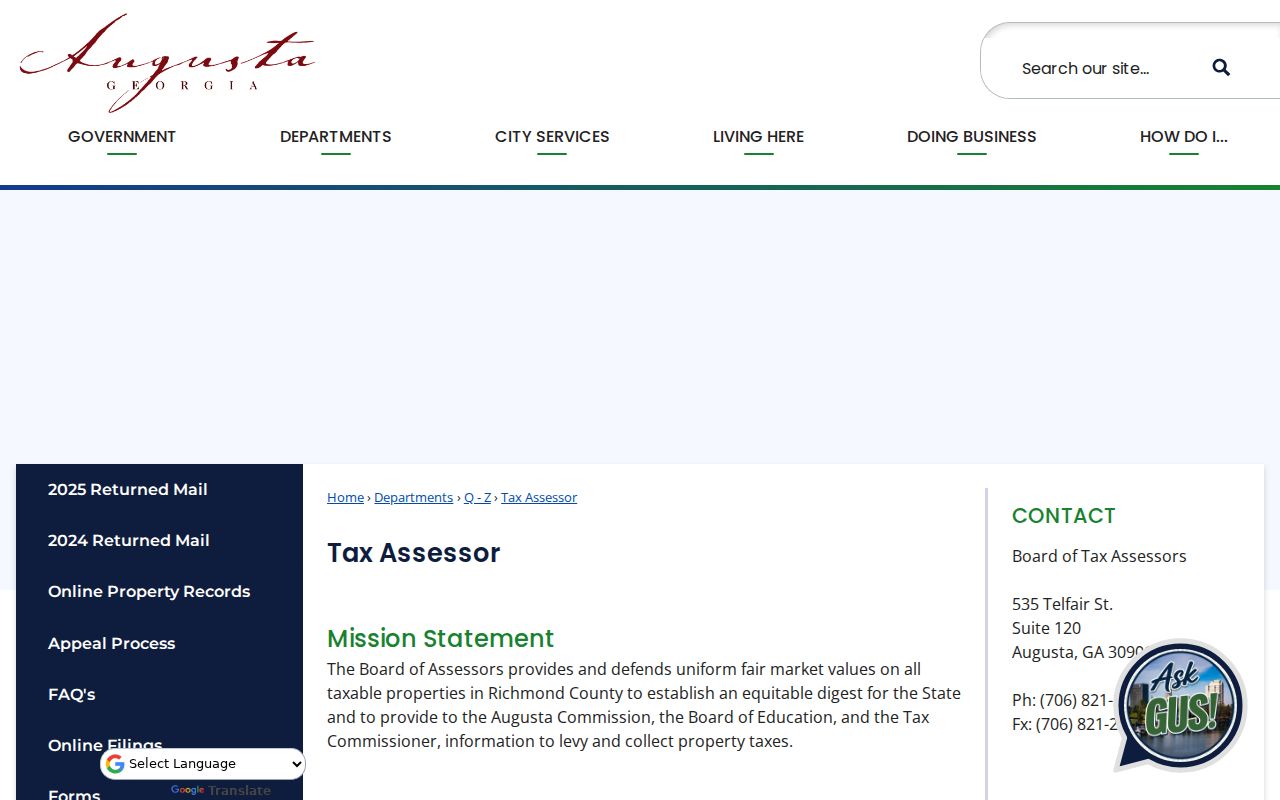
This official landing page is the fallback when the interactive parcel-value application is unavailable.
Look Up Richmond County Property Value
Start with an address to recover the PIN in a Richmond County property search. Then preserve the dated value fields before consulting the recorded transfer.
- Search the address in Richmond Property Search, confirming the PIN in GIS.
- Save market, assessed, land, improvement, exemption, and taxable fields with the year.
- Find the latest transfer in GSCCCA and retain its date and citation.
- Compare like properties and dates, noting physical changes and non-market transfers.
- Fair market value
- The assessor's mass-appraisal estimate.
- Assessed value
- Value after Georgia's 40 percent level is applied.
- Assessment ratio
- Relationship between assessed and fair market value.
- Sale consideration
- The amount tied to one transfer and its circumstances.
- Reassessment
- A valuation for a later tax year.
Annual Notices Fix the Date
Dates give Richmond County values their meaning. For 2026, notices were mailed June 29, and the published appeal deadline was August 13. Any quoted assessed value therefore needs its year and notice date. Contesting a notice belongs on the property-tax page. The valuation point is simply that later records may represent another cycle.
Tax District Is Not Market Value
The Tax Commissioner publishes urban, county/fire, Hephzibah, and Blythe district lines in Richmond County. Different millage changes the bill. It never changes the meaning of fair market value. Confirm municipal geography in Augusta-Richmond GIS, especially near cities excluded from the 1996 consolidation. A ZIP cannot select a tax district. So preserve the boundary label and PIN.
Last Sale Price Needs Context
A sale price on a Richmond County deed is not always a market price. Estate transfers, quitclaims, family conveyances, foreclosure instruments, partial interests, and unusual conditions may all fall outside an open-market deal. Search the GSCCCA index and read the instrument itself. Do not copy one sale field. Timing matters too. The tax roll may lag a new deed, and the bill goes to the January 1 owner of record, which explains temporary differences among owner, sale, and value records.
Flood and Historic Layers Add Questions
Richmond County GIS carries flood, zoning, historic-district, neighborhood, municipal, and parcel layers. These can flag diligence questions. They do not automatically quantify value. Compare genuinely similar parcel numbers and preserve the observation date.
The official legend separates FEMA A, AE, 0.2 percent annual-chance, and X or levee-protected categories. It also maps Downtown, Olde Town, and Summerville historic districts plus several National Register areas. Each label can prompt a permit, preservation, or condition question. No formula turns a layer into a dollar adjustment, though. A fair comparison records the layer. It confirms the parcel, and then weighs actual market and physical evidence.
Use Every Official Access Channel
If the assessor portal fails, fall back on the official landing page and office contacts. Richmond County tax information stays available through the Tax Commissioner portal and office. Recorded sale evidence comes from GSCCCA. It also comes from the Superior Court Clerk at 735 James Brown Boulevard, Suite 1500, Augusta, 706-821-2460. Records not online can be requested under the Georgia Open Records Act. Request them by address, PIN, type, and date range.
Phone guidance identifies the custodian. A deed supplies the durable citation. A dated assessment notice works too. The assessor sits at 535 Telfair Street, Suite 120, 706-821-2310. Ask for an existing assessment notice, parcel-card field, or valuation history, not a new appraisal. The Tax Commissioner at Suite 100, 706-821-2391, handles the annual tax bill.
Older context may require a recorded plat, permit, or aerial image. Augusta GIS offers imagery from 1949, 2010, 2011, 2014, 2018, and 2021. Those views can show that a structure changed. They can also show an access feature change. They cannot date construction precisely, and they cannot prove condition. Tie each observation to a permit, inspection, deed, or assessor record when possible.
What Richmond County Value Cannot Prove
An assessor value comes from mass appraisal built for taxation. It promises no sale price. It does not document current condition or establish title. It also cannot replace a property-specific inspection and appraisal in Richmond County. Renovation, deferred upkeep, private terms, estate circumstances, or a partial-interest transfer can each weaken one sale as a comparison. Those limits belong in your notes. Record them rather than forcing every figure into a single estimate.
Value vs price. Richmond County assessed value is a taxation figure, not what a property will necessarily sell for and not a property-specific appraisal.