
Read the Main Richmond County Property Tax Fields
The official sample bill walks a fixed sequence. Fair-market value becomes assessed value. Then come exemptions, taxable value, millage, and finally gross or net tax. Reading that chain stops a full market estimate from being confused with the smaller figure the tax formula actually uses.
| Field | What It Shows | Where |
|---|---|---|
| Fair-market value | The assessor's estimate of full value for the digest year | Assessment notice and bill |
| Assessed value | Georgia's 40 percent portion of fair-market value | Assessor and bill |
| Exemptions | Approved reductions applied before taxable value | Assessor and tax record |
| Taxable value | Assessed value less applicable exemptions | Tax bill |
| Millage and line items | District rates used to calculate gross and net tax | Tax Commissioner bill |
| Balance or delinquency | Payment, interest, penalty, Fi.Fa, or sale context | Tax Commissioner |
These property tax records never state a sale price. A recorded consideration amount is a different fact, and a current appraisal is a separate professional opinion.
Richmond County Splits Valuation from Tax Collection
Richmond County splits valuation and collection across two offices in one complex. The Board of Assessors sets uniform fair-market values. It mails assessment notices and hears appeals. The office sits at 535 Telfair Street, Suite 120, and answers at 706-821-2310. The Tax Commissioner, in Suite 100, runs the digest, billing, accounting, collections, exemptions, delinquency, and tax sales at 706-821-2391. Use the official assessor page for valuation questions. The Tax Commissioner property page covers the bill, due date, balance, and payment routes. Sharing a building does not merge their legal duties.
Look Up a Richmond County Property Tax Bill
Start with the parcel. Copy its PIN. Then use the official Tax Commissioner route, or request a current balance by bill number or map parcel.
- Confirm the parcel and exact PIN through GIS or the assessor entry.
- Open the official tax-payment route, or contact the Tax Commissioner with the bill number or map parcel.
- Match the tax year, owner shown, fair-market value, assessed value, exemptions, and taxable value.
- Read the current balance and preserve any delinquency, Fi.Fa, or tax-sale notice separately.
- Assessed value
- Forty percent of the fair-market value under the documented Georgia formula.
- Millage
- The rate applied to taxable value within the applicable district.
- Homestead exemption
- Approved property-tax relief tied to qualifying ownership and occupancy rules.
- Fi.Fa or tax lien
- A recorded enforcement claim associated with unpaid tax, subject to later payment or release.
The January 1 Richmond County Owner Rule Can Mislead
The owner of record on January 1 receives the property tax bill. A later sale that year changes nothing. The bill recipient is right for that tax cycle. But the recipient may not be the current owner of the parcel. Check the newest recorded deed and its recording date against the January 1 name.
This local quirk has practical force. A buyer reviewing a later sale should keep both dates. That is better than calling one record wrong. The deed proves a recorded transfer. The tax bill shows who was billed. That person is simply the county's addressee for that annual cycle.
Four Richmond County Tax District Lines Change the Rate
Four district lines set the rate. The Tax Commissioner publishes separate net millage figures for the urban district, county with fire service, Hephzibah, and Blythe. A mailing address proves little here. Augusta-Richmond consolidation left Hephzibah and Blythe out. Those cities kept their own lines. Save the GIS municipal-boundary result and the district printed on the bill, since this step matters near city edges, where an Augusta rate could wrongly land on an incorporated Hephzibah or Blythe parcel. Millage rates are annual records, not permanent attributes, so verify the live table for the tax year.
Use the Richmond County Assessor as the Value Source
The official Augusta-Richmond County Tax Assessor page identifies the valuation office.
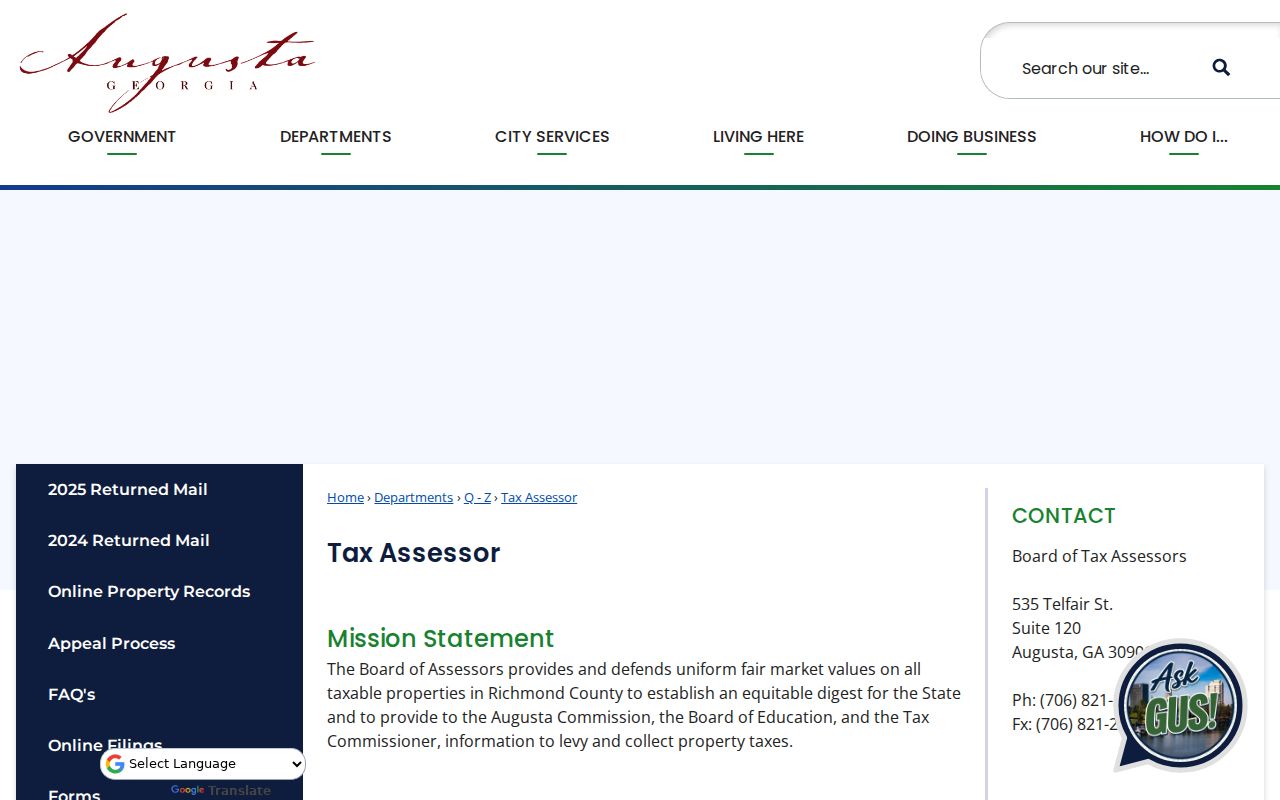
An assessment notice or value dispute belongs with that office. Payment status and collection questions stay with the Tax Commissioner.
Richmond County Property Tax Exemptions Change Taxable Value
The exemption summary documents homestead classifications along with senior, disability, veteran, and surviving-spouse relief. Eligibility rules differ by class. Evidence requirements differ too. The detailed homestead form asks for the parcel and applicant data, including ownership and occupancy facts, needed to decide a claim.
Use the current exemption summary and its official application route. Never assume that age, disability, veteran status, or residence creates relief automatically. Keep the filing confirmation, then compare the approved exemption with the later bill.
The PT-311-A Defines a Richmond County Assessment Appeal
The PT-311-A form defines the appeal. It captures the digest year, taxpayer, property ID, account, and description. The form also records property class, claimed value, and comments. A signature and any agent authorization complete it. Four routes appear. Choose Board of Equalization, arbitration, hearing officer, or direct Superior Court. Accepted grounds include value, uniformity, taxability, exemption denial, and covenant issues. Name the actual disputed field. Support it with comparable records, photographs, condition evidence, permit facts, or a professional analysis. It cannot reopen a closed assessment window to change a tax bill.
Meet the Richmond County Property Tax Appeal Window
Georgia sets a 45-day appeal period. It runs from the annual assessment notice. Richmond County set firm dates. In the 2026 cycle, notices were mailed June 29 and appeals were due August 13, 2026. The notice format also changed under Senate Bill 566 and now describes local floating homestead relief, so the notice year is essential context.
Appeal window. File within the 45 days printed on the current notice; the August 13 date applied to 2026 and should not be reused for another year.
Read Richmond County Delinquency and Tax-Sale Records Carefully
Delinquency sets a process in motion. The Tax Commissioner publishes the interest, penalties, notice, Fi.Fa, partial-payment, and sale procedures that follow. A sale listing is never the last word. Current status, payoff amount, recorded liens, and redemption rights still need checking. The official page showed one August 4, 2026 sale with 9:30 a.m. presale information at 535 Telfair Street, a dated event rather than a standing schedule.
Confirm the current list and status at 706-821-2391. Preserve the bill number or map parcel, tax year, notice, sale entry, and any later payment or cancellation. A stale downloaded list proves nothing about today's schedule.
Access Richmond County Property Tax Records Beyond the Portal
The Tax Commissioner gives property owners several options. Each one reaches the same Richmond County tax records. Use the website, call the office, or send mail. You can also drop documents in a drop-box or visit in person. A current-balance request works with either the bill number or the map parcel. Balances generally refresh nightly, per official information, so a figure quoted today may change tomorrow. These fallbacks help when the payment portal blocks access or when you need a dated receipt.
Records not posted online can still be requested under the Georgia Open Records Act. Describe the record narrowly and name the tax year. Ask for the bill, payment ledger, notice, or balance record that already exists. Do not request a new ownership analysis. Agencies may charge allowed retrieval or copy costs. Confirm exact card fees on the live official page before paying.
Keep every notice, bill, receipt, and delinquency entry as its own dated record. A mass bill file suits broad research. But the Tax Commissioner's notes show a warning. Adjustments, payments, weekly file refreshes, and nightly balance updates can leave a downloaded copy stale. For a payoff or sale question, request the current status instead of trusting an old spreadsheet. Always include the map parcel, bill number, and year. This helps staff locate the existing account. They won't guess which property or cycle you mean.