
Build a Richmond County Ownership Timeline
Every instrument reference is a handhold into the previous era. The newest conveyance is your first grip on the past. The GSCCCA Real Estate Index supplies party and recording references for modern transfers. The Superior Court Clerk holds the recorded instruments themselves. The chain may run older than the central index. Archival sources carry the search the rest of the way.
| Source | Years It Covers | Where Held | What It Shows |
|---|---|---|---|
| GSCCCA central index | Displayed from 1990 | Online statewide portal | Parties, instrument type, recording date and deed citation |
| Recorded deed books | Earlier county history | Superior Court Clerk and microfilm | Complete conveyance language and legal description |
| Plat index and subdivision maps | Varies by filing | GSCCCA and Clerk | Lot, block, phase, roads and adjoining land |
| Archive and library collections | Historic eras | Georgia Archives and Georgia Heritage Room | Deed-book cards, directories and contextual evidence |
The GSCCCA index reaches back to January 1, 1990. Its date form accepts earlier entries, though. That flexibility is not a promise of county-specific online completeness for Richmond County. Check the current good-from and good-through dates inside the portal, and shift to the Clerk or Archives once the chain crosses the cutoff.
Begin With the Newest Richmond Deed
The newest recorded deed anchors everything. Pull it up with the parcel's present owner, PIN, legal description, or latest book/page reference. A tax roll can lag behind a sale. A tax bill is addressed to the January 1 owner. So the newest deed is the better starting point. Before moving backward, save the grantor, grantee, instrument type, recording date, instrument number, book/page, and legal description.
The Richmond Clerk's real-estate office records deeds, liens, plats, and UCC filings. Visit the counter at the Judicial Center, 735 James Brown Boulevard, Suite 1500. That counter is the fallback when images fail. The official GSCCCA name search shows the controls used to move between grantor and grantee entries.
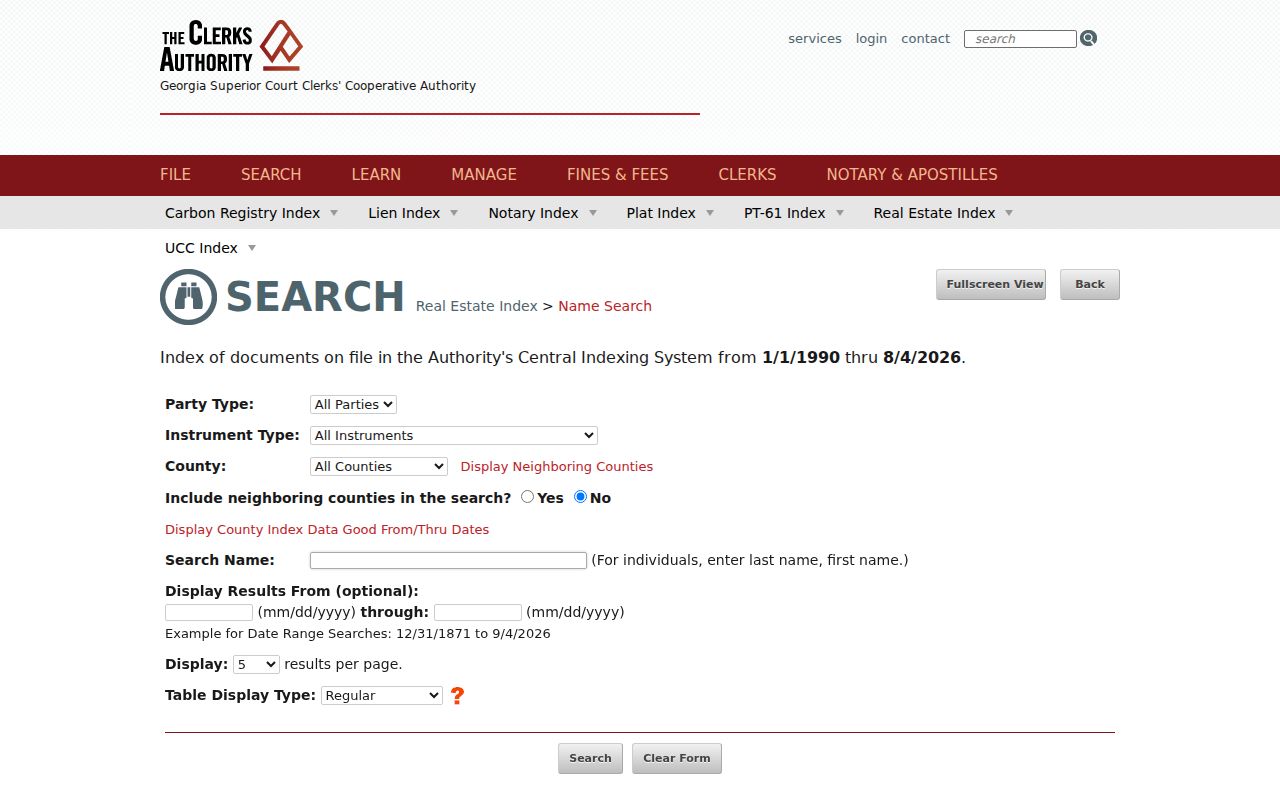
The portal view is the modern starting point. Save each deed citation before continuing into older Richmond County deed books.
Search Both Sides of Every Transfer
The GSCCCA name search uses two roles. Sellers appear as grantors. Buyers appear as grantees. Find the deed naming today's owner as grantee, note the seller, then search that seller as grantee over an earlier date range, repeating the two-direction check at every link. Name variants, initials, entity names, estates, and indexing differences can otherwise hide a transfer from the deed records.
| Search control | Use in a backward chain |
|---|---|
| County | Select Richmond and add nearby counties only when the legal description indicates a border issue |
| Party type | Alternate grantee for acquisition and grantor for disposition |
| Instrument type | Test deeds, executor or administrator instruments, quitclaims and trustee transfers |
| Date | Narrow around the prior citation, then widen if no match appears |
GSCCCA images may require an account or payment. The Clerk's office offers another route at 706-821-2460, real-estate option 2. A precisely keyed mail or records request works as well.
A Historic Richmond Deed Book Survives Online
The Georgia Archives catalog entry for Richmond Deed Book A-2 describes an indexed, microfilmed volume covering 1787 through 1791. Richmond's land-record trail runs deep. It reaches back well before the modern web index, but that does not make every old deed searchable by a modern address.
Archive county cards, deed-book citations, and microfilm form the bridge. Ask for the exact volume and page. Keep names as the old index spells them. Compare the land description against later plats. That human route can recover the ownership story of a house, an inherited tract, or a subdivision long after its street vocabulary changed.
Walk Richmond County Deeds Backward
Rebuild the chain one recorded link at a time. Never trust a results list alone. Compare the land description and deed reference at every step to confirm the right parcel.
- Confirm the parcel's PIN and legal description, then locate the current acquisition deed.
- Read the grantor on that deed and preserve its recording citation.
- Search that former owner as an earlier grantee and confirm the same land.
- Repeat until the verified online range ends, then continue by deed book, microfilm, Archives card, or Clerk assistance.
- Grantor / grantee
- The conveying party and the receiving party named in an instrument.
- Chain of title
- The ordered sequence of transfers affecting the same land.
- Reverse index
- An index organized to locate the receiving party, useful for finding how a seller acquired the parcel.
- Warranty / quitclaim deed
- Different forms of conveyance; the document must be read rather than treated as a guarantee from its label.
Use Plats When Addresses Stop Matching
Addresses eventually stop matching. That is where plats earn their keep. Augusta-Richmond GIS stores subdivision names, phases, sections, approval dates, developers, engineers, and lot counts, while the GSCCCA plat index adds search paths by county, subdivision, district, land lot, and date. A recorded plat can tie the present parcel to the older tract, lot, and block language in a prior deed.
Municipal geography matters too. Augusta and Richmond County consolidated in 1996. Hephzibah and Blythe stayed separate. Fort Gordon, now Fort Eisenhower, carries an added coverage caveat, so save the municipal boundary, PIN, subdivision, and legal description rather than trusting the city line on a mailing address.
Note: A ZIP code or modern street address is a locator, not a substitute for the recorded legal description.
Estate Transfers Can Bend the Owner Chain
Owners sometimes vanish from an ordinary deed sequence. Land may have passed through an estate, year's support, executor's deed, administrator's deed, trust, or court order. Search the deceased person's name in both directions. When the deed index points to an estate or litigation file, check the Richmond Probate and Superior Court routes.
The Georgia Courts e-access gateway requires an account through its provider, which makes the Clerk counter an important alternative. Probate packets may explain authority to convey. The recorded deed remains the land-record link. Restricted personal material is unnecessary for this work.
Augusta Directories Add Human Context
The Georgia Heritage Room at the Augusta library keeps city directories, newspapers, obituaries, and genealogy collections. These materials do not circulate. A directory can place a family at an address between two deed dates. It can also explain a street name that no longer exists. Remember, though, that occupancy is not ownership. An entry is a clue, and the deed chain must settle the question.
Ask the library about finding aids and reference help if you research from a distance. For the authoritative record of transfer, the Clerk's recorded book and page always wins. That split between human context and hard land evidence is real. It keeps a Richmond County ownership history honest.
How Far Richmond County Owner Records Reach
Richmond County deed books reach back into the eighteenth century, though online name searching covers only a much newer slice, and completeness varies by county. When the electronic trail runs out, carry the last book and page you have to the Clerk, then to Georgia Archives county cards and microfilm, using plats and library collections to sort out changed land descriptions. A null result may simply mark an index boundary, a spelling variant, a different county, or an unfamiliar record format rather than a missing former owner.
Online cutoff. The inspected central index displayed a 1990 start, so older Richmond former owners may require deed books and microfilm. Verify current county coverage before relying on that date.
Tracing previous owners of record in Richmond County supports house history, estate work, boundary diligence, and preparation for a professional title examination. It never licenses harassment of a living person. And an assembled chain is not a title opinion.