
Richmond County Deed Records by Instrument Type
The Richmond County Superior Court Clerk records deeds, liens, plats, UCC filings, and other land papers. GSCCCA supplies the statewide electronic index. Pick an instrument type first. That choice keeps a conveyance separate from financing. It also separates a later release from the original filing.
| Deed Type | What It Does | Common Use |
|---|---|---|
| Warranty deed | Conveys the stated interest with deed covenants | Ordinary sale in the recorded chain |
| Quit claim deed | Transfers whatever interest the grantor holds | Interest cleanup or family conveyance |
| Deed from estate or deed of gift | Records an estate-related or gifted transfer | Probate and family history |
| Trustee's, sheriff's, or foreclosure deed | Records a transfer through a named legal process | Distressed or court-linked property |
| Tax sale deed | Records the deed issued from a tax-sale process | Delinquent-tax research |
Not every name hit is a sale. A security deed, assignment, lien, release, right-of-way deed, or restrictive covenant can sit right beside the deed records without conveying the same interest. Read the label and the instrument's own text before drawing any conclusion from a Richmond County property search result.
The Richmond County Clerk Is the Recording Office
Georgia skips the separate register of deeds arrangement used elsewhere. So Richmond County has no such office. Recording lives with the Clerk of Superior, State and Juvenile Court. Superior Court itself holds authority over title-to-land and equity matters. The real-estate counter sits at the Judicial Center, 735 James Brown Boulevard, Suite 1500, Augusta, GA 30901. Call 706-821-2460 and choose option 2 for real estate questions. Before requesting a deed, lien, plat, UCC filing, or court-linked land record, verify the route with the Clerk's official description. A correction, a quiet-title dispute, or a foreclosure issue runs through this recorded and court trail. An assessor card alone will not carry it.
Trace Richmond County Deeds Through Grantor and Grantee
Every deed has two sides. The grantor gives the stated interest, and the grantee receives it. To build a Richmond County chain of title, find the current acquisition as a grantee record, open that deed, and carry the grantor's name into the next search. Reverse the direction to follow a transfer out.
- Select Richmond County and search the known owner as grantee.
- Filter toward the likely acquisition date and deed type.
- Open the match and save both parties, instrument number, recording date, and book/page.
- Search the grantor as grantee to move back one transfer, repeating until the online range ends.
- Grantor
- The party transferring the stated interest.
- Grantee
- The party receiving the stated interest.
- Chain of title
- The ordered sequence of land instruments affecting the parcel.
- Book/Page and instrument number
- Recording references used to distinguish and retrieve a filed document.
Set the Richmond County GSCCCA Search Controls
The GSCCCA Real Estate Name Search is the official statewide entry point, open to anyone at the form level, though viewing results and images requires a login. Its controls are built for a precise deed-records query.
| Control | Available choice | Search purpose |
|---|---|---|
| Party Type | Grantor or Grantee | Follow transfers in or out |
| Instrument Type | All or a named deed, lien, release, easement, order, and more | Separate conveyance from other filings |
| County | Richmond or statewide | Reduce same-name matches |
| Neighboring Counties | Yes or No | Expand only when geography supports it |
| Search Name | Up to 70 characters | Use last name, first name for people |
| Date and display | Date range, 5 to 100 rows, three layouts | Control volume and scan the timeline |
Short names face tighter rules. A name of two characters or fewer requires a county, an instrument type, both dates, and a range no longer than 365 days. That constraint forces a broad initial or abbreviated entity search to be deliberate rather than casual.
View the Richmond County Deed Index Entry Point
The official statewide real-estate index displays the fields used to search Richmond County parties and instruments.
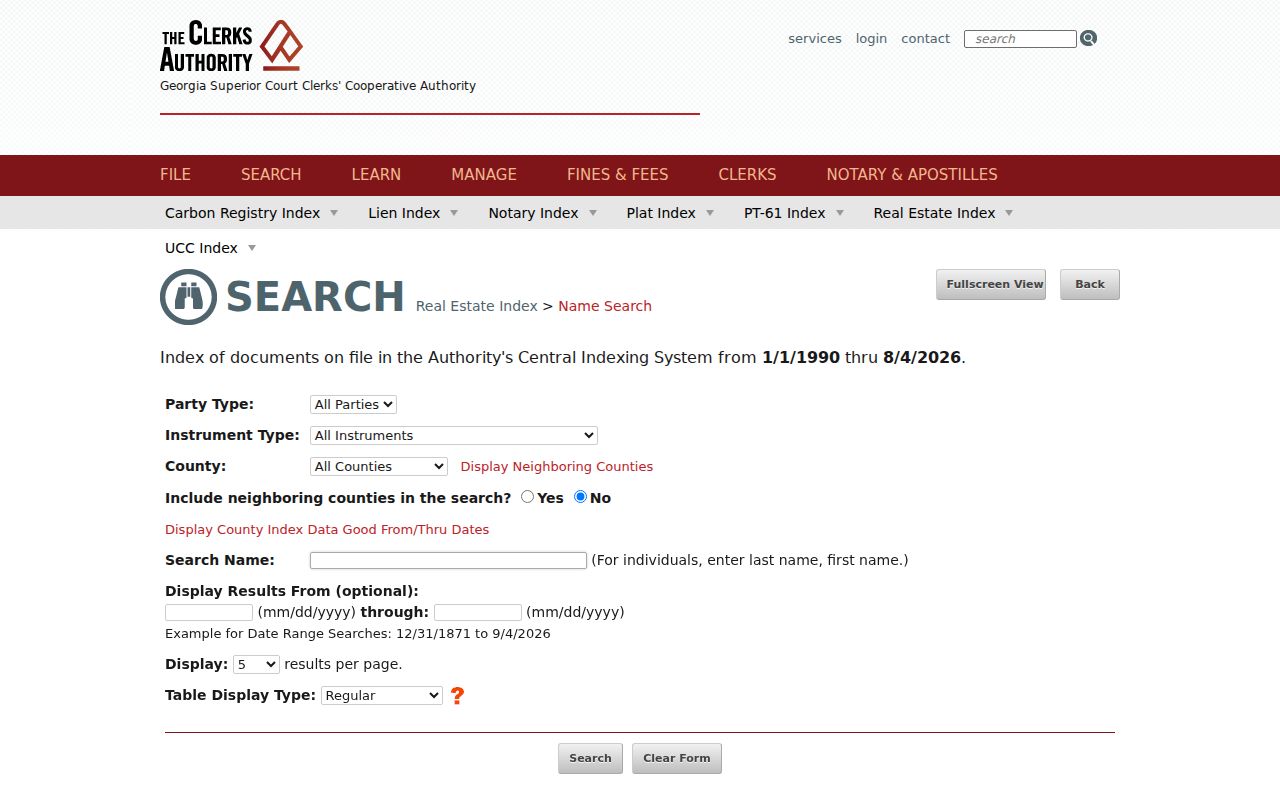
The form helps locate the recording reference. The matching image or certified copy still has to be pulled and read before the entry counts as evidence.
Use Book and Page for a Known Richmond County Deed
A citation from another record makes the GSCCCA book/page search the faster route. There is no need to repeat a name query. Its visible controls ask for county, book, and page. They also display county good-from and good-through information. Copy the citation exactly as the Clerk or index gives it. Old letters, prefixes, and formatting can matter more than they look.
The portal's central index displays coverage from January 1, 1990 through August 4, 2026. Broader date validation works behind the scenes. Confirm current county-specific coverage in the live system. The displayed statewide span is not proof that every Richmond County image starts on the same day.
Read Security Deeds and Releases Beside Richmond County Deeds
Georgia's recorded mortgage trail usually takes the form of a security deed. Follow the security deed itself, then any assignment, then a release or cancellation. Liens and materialman's liens can affect the record too. An easement, right-of-way deed, or restrictive covenant may control how the land is used. It does all this without changing the owner of record on the latest conveyance. One index entry never proves an obligation is still unpaid. It may have been released, corrected, superseded, satisfied, or challenged in the meantime. Keep the recording sequence and the legal description together. Bring in title or legal help when priority matters.
Richmond County Deed Books Reach Far Beyond the Online Display
Older Richmond County property records reach well past any online index. The Georgia Archives documents Richmond Deed Book A-2. It covers 1787 through 1791. It survives as an indexed, microfilmed volume. A holding like that reframes a missing modern index hit. It becomes an archive lead, not proof that no deed exists. Georgia Archives county cards carry a search back into the book era. Clerk volumes and library collections do the same. The White House tract history shows the method at depth. It ties a 1794 plat to references in Deed Book S for 1822 through 1826. College Hill material connects Henry Turknett's 1806 land to an 1886 deed. That deed sits in Book 3T, pages 705 through 707. Treat these as research models, not shortcuts around gaps in a particular chain.
Online cutoff. The inspected central index displayed a 1990 start; use Clerk terminals, deed books, Archives microfilm, and library aids for older Richmond County deed records.
Connect Richmond County Deeds to Plats and Covenants
A deed's legal description may point to a subdivision or a lot. It could also reference a block, phase, section, land lot, district, or an older tract. GSCCCA provides separate property and subdivision searches plus a plat search. The plat form covers county and neighboring-county choice. It also covers name, section or GMD, district, land lot, dates, and result-display controls. Read the recorded plat itself for roads, dedications, easements, and the original lot framework. Then check for later replats or vacations. GIS can help you find the area. Its parcel outline never replaces the recorded plat or a boundary survey. The full map workflow sits on the Richmond County parcel maps page.
Retrieve Richmond County Deed Records Online or at the Clerk
Getting deed records online usually means a GSCCCA account. Image access can carry a fee. The Clerk's public terminals are free. GSCCCA lists them at its offices. For certified copies, Richmond County runs an eCertification service that returns electronic certified documents. The counter still handles older deed books and stubborn references.
Have the details ready before you call. Party names, instrument type, recording date, instrument number, and book/page all help the Clerk pull the right deed records fast. Ask for a specific recorded document rather than a broad search. The Clerk does not publish exact copy and certification fees. Confirm the price and delivery method directly instead of assuming a statewide rate.
Know What Richmond County Deed Records Can Prove
A recorded deed proves one thing. The instrument entered the official record with the named parties and stated terms. It does not settle whether the grantor held good title, whether a competing interest wins priority, or whether an unrecorded claim is still out there. Corrective instruments, releases, court orders, and later conveyances all matter. One deed is rarely the whole story in Richmond County property records.
Recorded, not guaranteed. Richmond County deed records are public evidence, not a title opinion; consult a Georgia title professional or lawyer for a legal conclusion.